
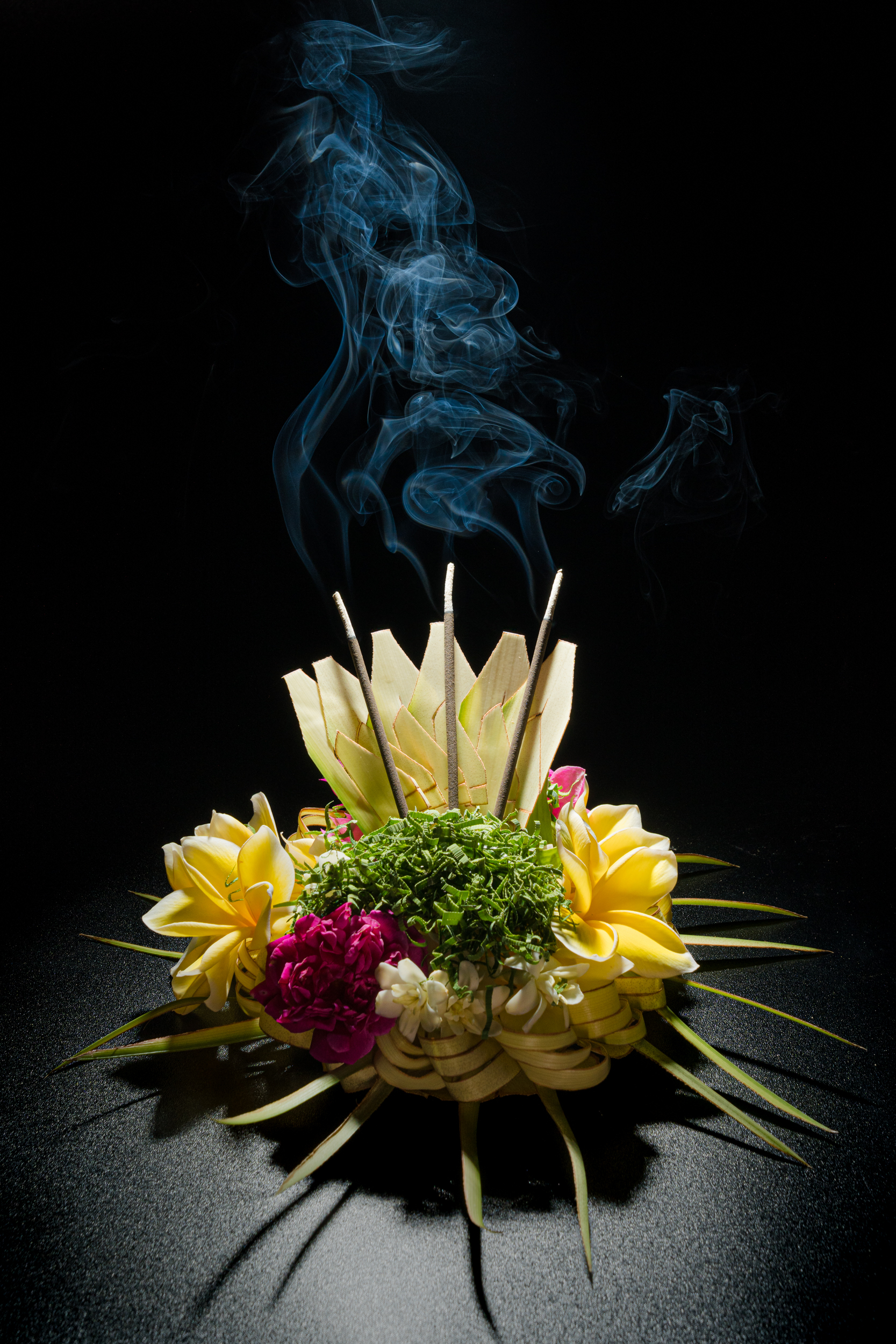
Canang sari are daily offerings in Balinese Hindu practice, often made in small palm-leaf baskets with flowers. Indonesia’s Ministry of Tourism describes them as expressions of gratitude and spiritual balance. For a visitor, a thoughtful response is simple: notice them, leave them undisturbed and give people space to carry out their practice.
A small offering with a place in everyday life
The flowers may catch your eye first, but canang sari belong to a living religious tradition. Indonesia Travel describes the palm-leaf basket and its offering elements, and places the daily practice within Bali’s wider cultural heritage. Understanding that context changes how you look: this is something meaningful to the people who prepare and place it.
You do not need to decode every colour or element to be a considerate guest. A short online introduction cannot explain every household’s practice. Let your curiosity begin with attention, and leave room for someone to explain in their own words if they wish.
Indonesia Travel: canang sari within Bali’s living heritage
Indonesia Travel: the palm-leaf basket and its offering elements
What should I do when I come across an offering?
Our practical suggestion is to slow down and give it room. Choose a path around an offering where you can, and avoid touching it or moving it to improve a photograph. If you cannot pass comfortably, ask someone nearby for guidance instead of deciding where it should go.
If someone is placing an offering or praying, wait without interrupting. Keep entrances and walking routes clear. Being welcome in a public area does not mean every nearby space is open to visitors; follow the instructions of the people responsible for the place.
Can I take a photograph?
Ask before photographing a person or their practice, and accept a refusal without trying to negotiate. A useful question is: “Would it be all right to take a photograph from here?” Permission to stand somewhere does not automatically include permission to photograph what is happening.
Even when a photograph is welcome, leave the offering as you found it. Do not rearrange flowers, pick up the basket or ask someone to repeat an action for your camera. Sometimes the most personal memory is the one you simply pause to notice.
Can visitors learn more or take part?
An invitation to learn is a starting point for a conversation. Ask what the activity involves, whether it is a demonstration or part of a religious practice, and what is appropriate for a guest. Observation, learning a craft and participation in worship are different experiences; clarify what is being offered before agreeing.
Let the person guiding you set the boundaries. Ask whether questions are welcome now or better saved for afterwards. You can be interested without expecting access, and you can decline participation respectfully if you would rather observe.
Make room for understanding
A meaningful encounter does not have to become another item to collect on a holiday. Leave enough time to listen, allow a conversation to end naturally and resist the urge to turn everything you see into something to recreate at home.
If cultural learning is part of what draws you to Bali, tell Bali Bohem what you are curious about when you enquire. The team can discuss possibilities and the permissions or practical details that would need confirming. Begin with a question, rather than an expectation of a particular ceremony.
Before reaching for your camera, pause and ask: is this a moment to photograph, a moment to ask, or a moment to leave undisturbed?
Further reading
Our prompts are editorial suggestions. Explore the guidance and background that informed this story.
Ministry of Tourism: Bali’s cultural heritageMinistry of Tourism: canang sari materials and cultural learning